
Quick Summary
The decisions you make in the first 72 hours after a car accident in metro Atlanta have a direct and lasting impact on your ability to recover full compensation. From securing the scene and getting medical care to knowing which calls to take and which calls to decline, the right moves in those early hours build the foundation for everything that follows. This guide walks through what matters most, in order.

A Step By Step Guide
The car or truck accident just happened. Your heart is still pounding. You are not sure if you are hurt. The other driver is out of their car. You have no idea what to do next.
This guide is for that moment, and for the 72 hours that follow. What happens in this window shapes everything about your ability to recover, financially and physically. The mistakes made in these early hours are often the most costly ones.
The Scene of the Accident: What to Do First
Check yourself and your passengers for injuries. Before anything else, assess whether you or anyone in your vehicle is hurt. If there are serious injuries, do not move injured people unless they are in immediate danger (from a fire, for example). Call 911 immediately.

Move to safety if you can. If the accident is minor, your vehicle is drivable, and staying on the road would create additional danger, move your vehicle to a safe location off the active roadway, such as a parking lot or the shoulder. Turn on your hazard lights. If the vehicles cannot be safely moved, remain in your vehicle with your seatbelt fastened until police arrive.
Call 911. Always call police after a car accident in Georgia, even for minor accidents. A police report is an official record of what happened, who was involved, and any citations issued. It is one of the most important documents in your personal injury or property damage claim. Do not rely on the other driver’s promise to “handle it between the two of us.”
Do not admit fault. In the adrenaline of the immediate aftermath, it is natural to say things like “I’m so sorry” or “I didn’t see you.” These statements can be recorded, reported to insurance companies, and used against you as admissions of fault. Express concern for the other driver without characterizing what happened or who was responsible.
Exchange information with the other driver. Get the other driver’s full name, address, phone number, driver’s license number, license plate number, and insurance company name and policy number. If the at-fault driver does not have insurance, document everything you can about them and their vehicle.
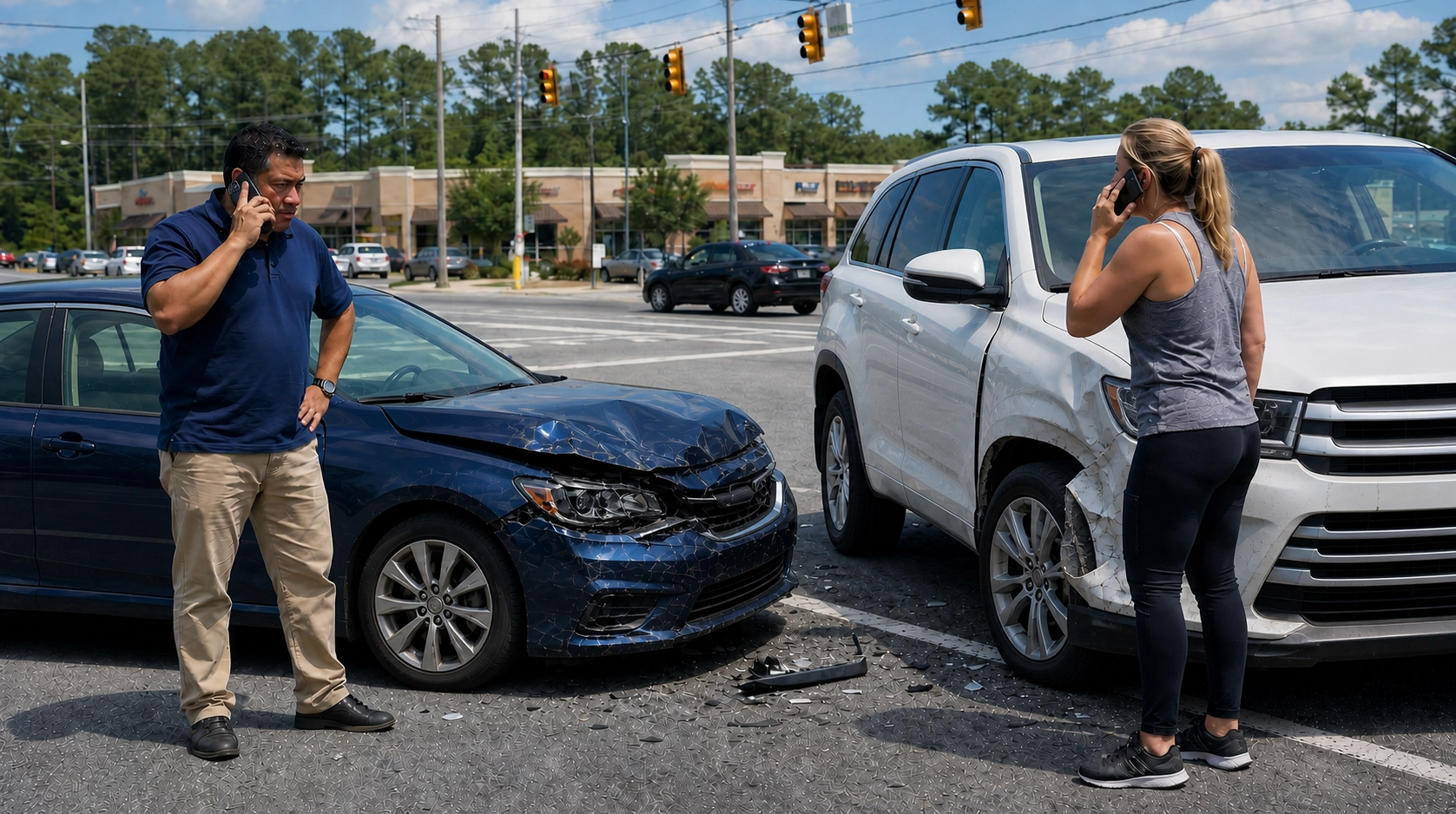
Document the scene thoroughly. Use your phone to photograph the vehicles from multiple angles, the damage to both cars, the road conditions, any traffic signals or signs relevant to the accident, skid marks, debris, and the overall scene. Photograph your injuries as well. This visual record is often more compelling than any written description.
Get witness information. If anyone saw the accident, ask for their name and phone number before they leave. Witnesses often drive away before police arrive. Their testimony can be critical if fault is disputed.

Immediate Medical Care: Why This Cannot Wait
The most costly mistake many Georgia accident victims make is declining immediate medical care.
The reason people do it is understandable. You might not feel seriously hurt. The accident might seem minor. You do not want to go to the hospital if it turns out you are fine. You have things to do.
But this decision has two serious consequences.
First, many serious injuries do not present immediately. Soft tissue injuries, including whiplash, muscle damage, and ligament tears, often become most painful 24 to 72 hours after the accident, not immediately. Traumatic brain injuries can present initially as mild headache or confusion and become more severe over days. Adrenaline at the accident scene genuinely suppresses pain.
Second, declining or delaying medical care creates a gap in your records that insurance companies use against you. The standard argument goes like this: if you were really hurt, you would have gone to the hospital immediately. If you waited three days, your injuries must not be related to the accident. This argument is legally and medically inaccurate, but it works on people who do not have legal representation helping them push back.
Accept the ambulance if you feel any pain or discomfort. Go to an urgent care or emergency room if you choose not to take the ambulance. See your primary care physician within 24 hours if your injuries seem manageable. The key is that you create a medical record tied to the accident, as soon as possible after the accident.
Tell every medical provider the full truth about your symptoms. Do not minimize your pain because you think the accident was minor or because you do not want to seem dramatic. Let the medical professionals make the clinical determination about what is going on with your body.
The Insurance Calls: What to Say and What Not to Say
In the first 24 to 48 hours after a Georgia car accident, you will likely receive phone calls from one or more insurance companies.
Your own insurer. Georgia law requires you to promptly notify your own insurance company of an accident. When you speak with your own insurer, provide factual information: the date, time, and location of the accident, a description of what happened, and the other driver’s information. You do not need to characterize fault or give a lengthy recorded statement.
The other driver’s insurer. This is the call you need to be most careful about. The other driver’s insurance adjuster is not working in your interest. They will call you quickly, often within 24 hours of the accident, and they will sound helpful. They may ask to take a recorded statement. They may tell you it is routine.
Do not give a recorded statement to the other driver’s insurance company without speaking to an attorney first. You are not legally required to do so, and a statement taken before you have legal guidance can be edited and presented out of context in ways that reduce your recovery.
Accept no settlement offers in the first 72 hours. You do not fully understand the extent of your injuries yet. You have not had a chance to assess your medical bills, your lost income, or your long-term prognosis. Any settlement offer made in the first few days is almost certainly a low offer designed to close your case before you understand what you are actually owed.
Preserving Evidence Before It Disappears
The 72 hours after an accident are also the window when critical evidence is most at risk of disappearing.
Camera footage. Most business security systems retain footage for 30 to 90 days before overwriting. Traffic camera footage may be retained for even shorter periods. If the accident occurred near businesses with exterior cameras, that footage exists right now and may be gone in a month. An attorney can send a preservation letter within hours of being retained.
Vehicle data. Modern vehicles record electronic data about speed, braking, acceleration, and airbag deployment. This event data recorder information can be critical in fault disputes. It may be overwritten by subsequent driving. A prompt request to preserve this data is important in serious accidents.
Physical evidence at the scene. If there are skid marks, debris, or physical markings at the accident location, photograph them as soon as possible. Road crews sweep and resurface roads. Weather changes and washes away evidence. What is clearly visible today may be gone in a week.
Your own physical evidence. Photograph your injuries daily in the days following the accident. The bruising, swelling, and visible damage from a car accident often peaks 48 to 72 hours after the crash, not immediately. These photographs document the real impact of the accident on your body.
The First Call to an Attorney: When and Why
The best time to contact a personal injury attorney after a car accident is as soon as possible after you have addressed immediate medical needs.
You do not need to wait until you know the full extent of your injuries. You do not need to wait until you have all your medical bills. You do not need to wait until the insurance company has made an offer.
The attorney’s job in the early phase of a case is to help you avoid mistakes, preserve evidence, and establish the groundwork for a strong claim. The sooner they are involved, the more they can do on these fronts.
Most personal injury attorneys, including the team at 770GoodLaw, work on a contingency fee basis, meaning there is no fee unless they recover money for you. The first consultation is free. Calling costs you nothing. Not calling can cost you significantly.
In the Next 72 Hours: A Summary Checklist
The actions that matter most in the first three days:
- Seek medical care immediately, or within 24 hours if you chose not to go to the hospital at the scene
- Get a copy of the police report
- Photograph your injuries daily as they develop
- Write down your detailed account of the accident while it is fresh, including everything you remember about the other driver’s behavior
- Do not give a recorded statement to the at-fault driver’s insurance company
- Do not post anything about the accident on social media
- Do not sign any documents from the insurance company
- Contact a personal injury attorney
At 770GoodLaw, attorney Alex Nguyen and the legal team serve accident victims throughout Gwinnett County, DeKalb County, Cobb County, Norcross, and Riverdale. The four contractual guarantees built into every client agreement mean that from your first call, you know exactly what to expect and exactly what is being done on your behalf.
Call (770) GOOD-LAW for a free case evaluation. We can start coordinating your rental today.