
Quick Summary
Georgia’s modified comparative negligence law means you can still recover money after a car accident even if you were partially at fault, as long as your share of blame is 50% or less. Insurance adjusters routinely inflate your fault percentage to reduce what they owe you. Understanding how this law actually works is the difference between walking away with fair compensation and accepting a lowball offer that does not cover your real losses.

What The Law Says
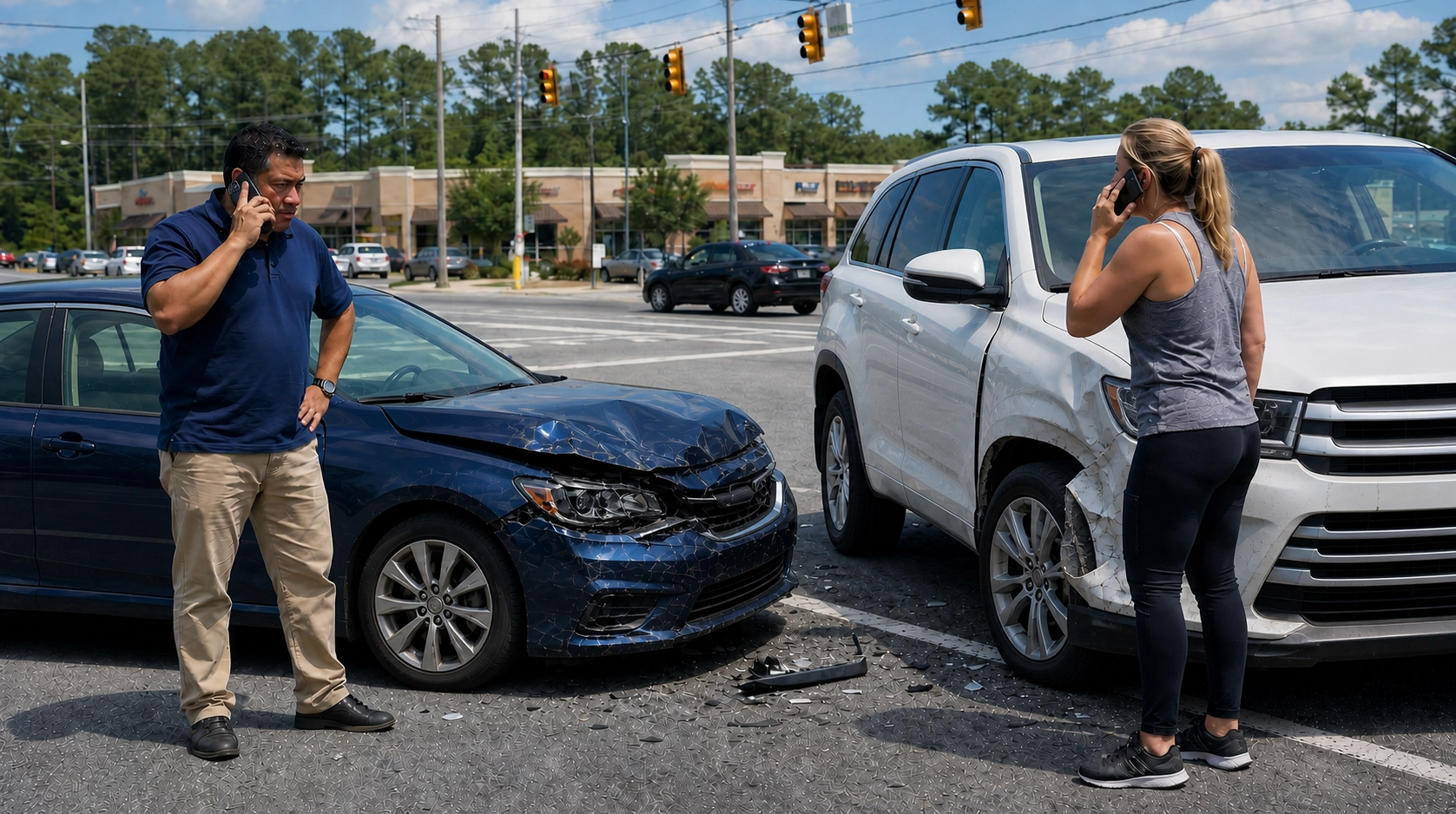
You were in a car accident in Atlanta. Maybe you were going a few miles over the speed limit. Maybe you were in the left lane when you should have merged right. Maybe your brake lights had been out for a week and you kept meaning to fix them.
Now the other driver’s insurance company is telling you that because of your role in the accident, your claim is worth far less than you expected. Maybe they’re telling you it is worth nothing at all.
Here is what they are not telling you: Georgia law is designed to protect people in exactly your situation. And insurance adjusters know it.
The real problem is not your partial fault. The real problem is that insurance companies have turned Georgia’s comparative negligence law into a weapon they use against people who do not know how it actually works.
What Georgia’s Comparative Negligence Law Actually Says
Georgia follows what is called a modified comparative negligence rule, codified under O.C.G.A. 51-11-7. The law says this: if you were injured in an accident, you can still recover compensation as long as you were not more than 50% at fault.
If you were 49% at fault, you can still recover. Your compensation is reduced by your percentage of fault, but you can recover.
If you were 50% at fault, the law allows recovery.
If you were found to be 51% or more at fault, you cannot recover under Georgia’s comparative fault rule.
That is the law. That is the entire threshold. The question is not whether you had any fault. The question is how much fault, and whether it crosses that line.
Most accident victims who were partially at fault are nowhere near 51%. They were looking at their phone for three seconds. They rolled through a stop sign at an intersection with no cross traffic. They made a lane change without signaling. These are real factors that may reduce a claim, but they rarely approach the level that would eliminate it.
How Insurance Adjusters Use Comparative Negligence Against You
This is the hidden problem that most injured people in Gwinnett County, DeKalb County, and across Georgia never see coming.

When an insurance adjuster calls you in the days after an accident, they are often not trying to figure out what actually happened. They are building a case for why your fault percentage is as high as possible.
They will ask you questions that sound like casual follow-up. “Were you familiar with that intersection?” “Had you driven that route before?” “Were you traveling at the posted speed limit, or were you going a little over?” Every answer you give is evaluated for whether it can be used to push your fault percentage higher.
They will pull your accident report and look for anything that supports assigning you more blame. They will sometimes get their own accident reconstructionist before you have even hired an attorney. And they will use your own statements against you.
Here is the critical part: they inflate your fault percentage because every percentage point they add to your share reduces what they owe you by that same percentage. If your claim is worth $100,000 and they can convince you (or a jury) that you were 40% at fault, they only owe you $60,000. If they can push that to 49%, they owe $51,000. If they can push it past 50%, they potentially owe you nothing.
This is not a legal strategy. It is a claims management strategy, and it works on people who do not understand the law.
What “Partial Fault” Actually Looks Like in Real Cases
It is worth being specific about what comparative negligence typically involves in Georgia car accident claims, because most accident victims significantly overestimate their own fault.
Speeding slightly. If you were traveling 37 mph in a 35 mph zone when someone ran a red light and T-boned you, you were technically speeding. An adjuster might claim this contributed to the accident. In most fact patterns, this kind of minor speed variance contributes minimally or not at all to fault, and an experienced attorney can argue this effectively.
Distracted driving. If you glanced at your navigation app and then were rear-ended, the question is whether your distraction was a proximate cause of the crash. If someone hit you from behind while you were stopped or slowing, your distraction generally did not cause that collision.
Not using a seatbelt. Georgia law does not allow your failure to wear a seatbelt to be used to reduce your damages in a personal injury case. This is a separate rule that many adjusters try to imply is relevant when it legally is not.
Entering traffic without full clearance. If you were pulling out of a parking lot or making a left turn and the other driver was speeding significantly beyond the limit, fault is shared based on the specific circumstances. Your portion of fault in these cases is often much lower than what the insurance company initially claims.
The point is not that fault does not matter. It does. The point is that insurance companies have a financial motive to tell you your fault percentage is higher than it actually is, and many accident victims accept that story without question.
How an Attorney Changes the Comparative Negligence Calculation
When you work with a car accident attorney in Atlanta, one of the most important things that attorney does is investigate and document what actually happened, not what the other insurance company says happened.
This means pulling surveillance footage from nearby businesses and traffic cameras before it is deleted. It means hiring accident reconstructionists who can analyze vehicle damage, skid marks, and impact data to establish speed and point of impact. It means reviewing police reports for inaccuracies and, when warranted, working to correct them.
It also means making sure you do not say anything to the insurance adjuster that gets used to inflate your fault percentage. One of the most damaging things an accident victim can do is give a recorded statement to the other party’s insurance company without legal guidance. That statement becomes part of your case file and can be used against you.
At 770GoodLaw, attorney Alex Nguyen and the legal team approach comparative negligence disputes with the understanding that the insurance company’s initial fault assignment is rarely the accurate one. It is a starting position in a negotiation, and the question is whether you have the documentation and legal representation to push back on it.
The Difference Between 49% and 0% in Your Settlement
Comparative negligence does not just affect whether you can recover. It directly affects how much you recover.
Consider a scenario where your total damages, including medical bills, lost wages, and pain and suffering, total $200,000. If an insurance company can get you to accept that you were 40% at fault, your recovery becomes $120,000. If your attorney can document that you were actually 15% at fault, your recovery becomes $170,000. That difference is $50,000, and it comes entirely from the fault percentage dispute.
This is why comparative negligence is so important to fight. Even small adjustments to your assigned fault percentage translate directly into significant dollars for injured Georgians.
It also explains why insurance companies push so hard on this issue. Every point of fault they add to your percentage is money that stays in their pocket.
Frequently Asked Questions About Comparative Negligence in Georgia
Can I file a claim if I was not wearing a seatbelt?
Yes. Georgia law does not permit the failure to wear a seatbelt to be introduced as evidence of comparative negligence in a personal injury case. Your seatbelt status does not reduce your claim.
What if the police report says I was partially at fault?
A police report is an important document, but it is not the final word on fault. Police officers are often working from limited information at the scene. An attorney can investigate further and present evidence that contradicts or clarifies what the report suggests.
What if I said something to the adjuster that made it sound like I was at fault?
This is common and it does not automatically end your case. An attorney can provide context, gather additional evidence, and work to establish the actual facts. The sooner you get legal help after an accident, the better your ability to shape the record.
Does comparative negligence apply differently in Gwinnett County vs DeKalb County?
The law is the same across Georgia. Local court practices and jury tendencies may vary, but the legal standard under O.C.G.A. 51-11-7 applies everywhere in the state.
How long do I have to file a personal injury claim in Georgia?
Generally, you have two years from the date of the accident to file a claim under Georgia’s statute of limitations. There are exceptions that can shorten or extend this window. Do not wait.
What to Do If Comparative Negligence Is an Issue in Your Claim
If the other driver’s insurance company is already raising your fault percentage as a reason to reduce or deny your claim, here is what matters most right now:
Do not give a recorded statement to the other party’s insurance company without speaking to an attorney first. Do not sign any releases or settlement agreements. Document your injuries with medical records. Preserve any evidence from the accident scene, including photos, witness contact information, and dashcam footage if you have it.
Georgia’s comparative negligence law is meant to protect people like you. It is one of the reasons you can still pursue a fair recovery even when the accident involved some complexity or shared responsibility.
The attorneys at 770GoodLaw serve clients across Gwinnett County, DeKalb County, Cobb County, Norcross, and Riverdale. Alex Nguyen has built his practice around the understanding that insurance companies count on victims not knowing their rights. The four contractual guarantees built into every client agreement reflect that commitment to accountability.
Call (770) GOOD-LAW for a free case evaluation. We can start coordinating your rental today.