Quick Summary
MARTA bus accident cases are governed by specific Georgia laws that give you a dramatically shorter window to file than a standard car accident claim. You have only six months from the date of the accident to file an ante litem notice, not the standard two years, and missing this deadline typically bars you from recovery entirely. These cases also involve commercial insurance with much higher policy limits, making them far more complex and far more valuable than most accident victims realize.

What Makes These Cases Different (and Why You Need Help Fast)
You do not have two years.
Most people who are injured in a car accident in Atlanta know they have roughly two years to pursue a personal injury claim. That two-year statute of limitations is widely referenced in personal injury law, and it gives most accident victims what feels like a reasonable amount of time to recover, understand their options, and decide how to proceed.
If you were injured in a MARTA bus accident, that timeline does not apply. You have six months.
Under O.C.G.A. 36-33-5, injuries involving government entities, including MARTA, which is the Metropolitan Atlanta Rapid Transit Authority, require that the injured party file what is called an ante litem notice within six months of the date of injury. This is not a suggestion. It is a mandatory legal prerequisite to filing a lawsuit. If you miss this deadline, you lose your right to sue, regardless of how serious your injuries are or how clear MARTA’s liability is.
This is the first thing you need to understand about MARTA bus accident cases in Georgia. They play by different rules.
What Is MARTA and Why Does It Get Special Legal Treatment?
MARTA is a government entity, a regional transit authority serving the Atlanta metropolitan area, including Fulton, DeKalb, Clayton, and Gwinnett Counties. Because it is a government authority, claims against MARTA are governed by the Georgia Tort Claims Act and specific notice requirements that apply to claims against governmental entities.
Private drivers who cause accidents are subject to standard personal injury law. Government entities like MARTA are protected by sovereign immunity, which historically shielded governments from lawsuits entirely. The Georgia Tort Claims Act and related statutes have partially waived that immunity, but only when the specific procedural requirements are met, including the ante litem notice requirement.
This is not a technicality that courts waive when the circumstances are sympathetic. Courts apply these deadlines strictly. An accident victim who was catastrophically injured in a MARTA bus crash but who waited nine months to file an ante litem notice has, under Georgia law, given up their right to pursue the claim.
Six months from the accident. That is the window.
What Types of Accidents Fall Under the MARTA Umbrella
MARTA operates several types of transit that generate different accident scenarios.

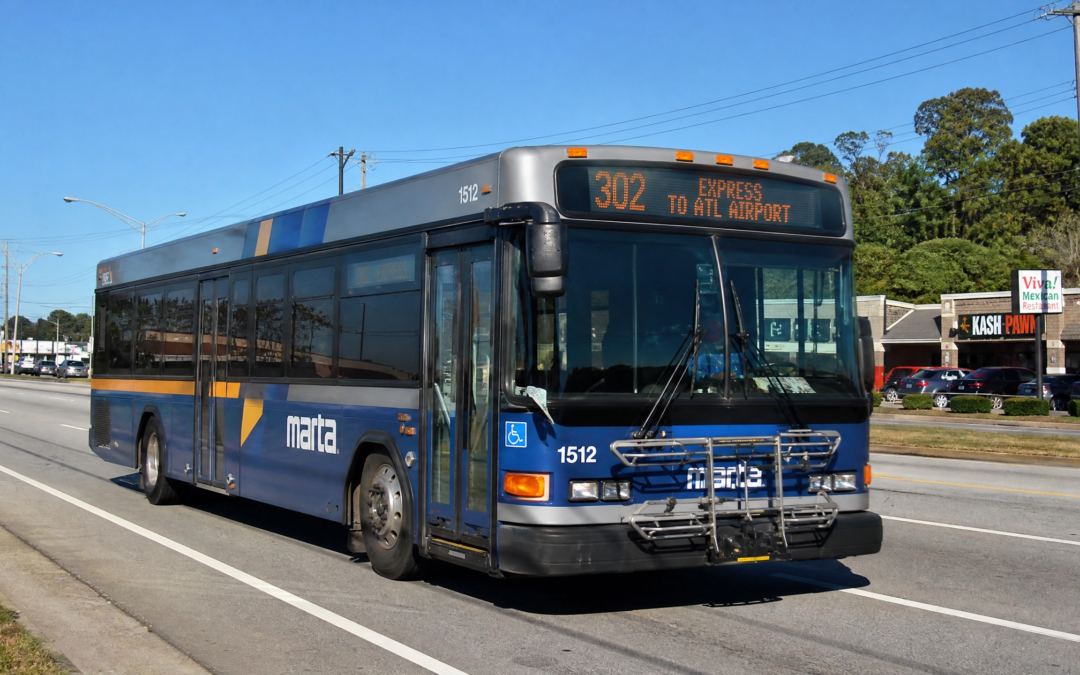
MARTA bus collisions are the most common. MARTA buses operate throughout the Atlanta metro area, including routes that pass through Gwinnett County, DeKalb County, and Cobb County. A MARTA bus that fails to yield, runs a light, or strikes a vehicle in an intersection creates a potential claim against MARTA.
Passenger injuries on MARTA buses include falls due to sudden stops or acceleration, slip-and-fall injuries inside the bus, and injuries caused by overcrowding or defective equipment. If you are a passenger and are injured, MARTA owes you a high duty of care as a common carrier.
MARTA rail accidents involve the heavy rail system that runs through Atlanta. These accidents are less common but often severe, and they carry the same ante litem requirements.
MARTA Mobility service accidents involve the paratransit service MARTA operates for disabled individuals. These accidents fall under the same legal framework.
In any of these scenarios, the clock starts running from the date of the incident.
Why MARTA Bus Accidents Involve Different Insurance Dynamics
This is the part of MARTA bus accident law that most accident victims never hear until it is too late to fully benefit from it.
MARTA, as a government transit authority operating commercial vehicles, is insured at levels far above the minimum required for private drivers. While a private driver in Georgia may carry $25,000 per person in bodily injury coverage, MARTA’s insurance exposure in a serious accident is in an entirely different category.
This matters because the severity of injuries in bus accidents is often high. A MARTA bus weighs approximately 30,000 to 35,000 pounds fully loaded. When a vehicle of that size and weight strikes a passenger car or causes a passenger to be thrown inside the bus, the forces involved can cause serious orthopedic injuries, traumatic brain injuries, spinal damage, and other catastrophic harm.
When the policy limits are high and the injuries are serious, the complexity and value of the case increases significantly. These are not claims that can be handled the same way as a fender bender with a private driver. They require a different investigation strategy, a different approach to documentation, and a different understanding of how government entities respond to litigation.
The Investigation That Has to Happen Immediately
Given the six-month ante litem window, and given how quickly critical evidence disappears, the investigation into a MARTA bus accident has to begin as soon as possible after the crash.
MARTA maintains data recorders on its buses, similar to the black boxes found on commercial trucks. These recorders capture speed, braking, acceleration, and other operational data from the moments before and during a crash. This data must be requested and preserved before it is overwritten.
MARTA buses are also equipped with security cameras, both exterior and interior. This footage captures the accident itself, the positions of vehicles involved, and the conditions inside the bus at the time of the crash. Like all security footage, it has a limited retention window and must be formally requested before it is deleted.
MARTA also maintains driver records, maintenance logs, and accident history for its vehicles and operators. If a driver had prior safety violations, or if the bus had a mechanical issue that contributed to the crash, that information exists in MARTA’s records and must be obtained through formal legal channels.
An attorney can issue a preservation letter immediately, putting MARTA on notice that all evidence related to the accident must be maintained. Without this step, evidence can disappear, and your ability to prove what happened diminishes with every passing week.
The Ante Litem Notice: What It Requires and What Happens If You Miss It
The ante litem notice is a formal legal document that must be served on MARTA within six months of the accident. It must include specific information:
- The name and address of the person filing the notice
- The date, time, and place of the accident
- A description of the nature of the claim and the specific injuries or losses claimed
- The amount of compensation being sought
If any of these elements are deficient, or if the notice is not served correctly on the right party, it may be treated as invalid. Serving a deficient ante litem notice and then relying on it as if it were valid is one of the more common and costly mistakes in MARTA accident claims.
The ante litem notice must be served on MARTA specifically, not on a bus driver, not on a general Atlanta transit authority office, and not on a representative who accepts it informally. It must follow the specific procedures under Georgia law.
After the ante litem notice is served, MARTA has 30 days to respond. If they offer a settlement, you can accept or reject it. If they do not respond or if their offer is insufficient, you then have additional time to file a formal lawsuit.
Frequently Asked Questions About MARTA Bus Accidents in Georgia
What if I was a pedestrian hit by a MARTA bus?
The same ante litem requirements apply. If a MARTA bus struck you while you were crossing a street or in a crosswalk, you have six months from the date of the accident to file your ante litem notice.
What if my injuries were not immediately apparent?
This is one of the most common issues in MARTA accident cases. Soft tissue injuries, traumatic brain injuries, and spinal injuries often do not present their full severity immediately. The six-month clock runs from the date of the incident regardless of when you realized the full extent of your injuries. Do not wait for your injuries to fully develop before seeking legal guidance.
Can I still recover if I was partially at fault?
Georgia’s comparative negligence law applies in MARTA accident cases as well. If you were partially at fault, your recovery may be reduced proportionally, but you can still recover as long as you were not more than 50% responsible.
What if the MARTA driver was at fault but I cannot prove it yet?
You do not need to have your case fully built to file the ante litem notice. The notice preserves your right to pursue the claim. The full investigation and evidence gathering continues after the notice is filed.
Is my case worth pursuing even if my injuries seem moderate?
Yes. MARTA accident cases involve commercial insurance with higher limits than private driver policies. Even moderate injuries can generate significant medical expenses and lost wages, and the combination of those losses can justify a substantial claim.
Serving Gwinnett County, DeKalb County, and the Greater Atlanta Area
At 770GoodLaw, attorney Alex Nguyen and the legal team handle MARTA bus accident claims for clients across Gwinnett County, DeKalb County, Cobb County, Norcross, Riverdale, and the broader Atlanta metro area. Alex understands that clients who have been injured in a MARTA accident are often confused about their rights and often do not realize that the clock is already running.
The four contractual guarantees built into every 770GoodLaw client agreement reflect a commitment to transparency and accountability that starts on day one. That includes being honest with you about what your case requires and how little time you may have to protect it.
If you were injured in a MARTA bus accident in Atlanta, do not assume you have the standard two years. You almost certainly do not.
Call (770) GOOD-LAW for a free case evaluation. We can start coordinating your rental today.